A meandering blog with no clear topic. You will find me talking about knitting, building, kids, social and economic issues, Alaska, and lots of other stuff.

Showing posts with label food. Show all posts

Friday, July 24, 2009

fireweed jelly


The other day, I made fireweed jelly. Fireweed runs rampant around southcentral Alaska, and we have lots of it on our property. Since last summer, I have wanted to make jelly with it, and I finally got around to it. Ryan and I picked two shopping bags full of fireweed blossom ends, which left no noticeable dent in our fireweed population. Then we picked all the blossoms off the stems:


Then rinsed them, put them in a pot with some water, and heated them until the blossoms lost their color, which only took a few minutes. Then strained the water, which then was actually fireweed juice. The fireweed juice was an ugly light yellowish brown, not at all what I expected.

To the fireweed juice, I added sugar and a little lemon juice. As soon as I added the lemon juice, the mixture turned a beautiful pinkish-purplish color, the color of the blossoms. Very interesting chemical reaction, I thought.

I then brought the mixture to a boil, added pectin, boiled for another minute, and poured into jars. Sealed the jars, and voila! fireweed jelly, 28 1/2 pint jars. This isn't the greatest picture, but the jelly is a beautiful rich clear pink color. And delicious!

I really enjoyed this experiment, because I was able to harvest something that grows wild and abundantly on my property, and turn it into something delicious for my family.

Friday, July 10, 2009

first fruits

Had my first strawberries of the season last night, after the sun had been on them all day, warming them and making them juicy. Yummm.......


Thursday, July 9, 2009

mary, mary, quite contrary...

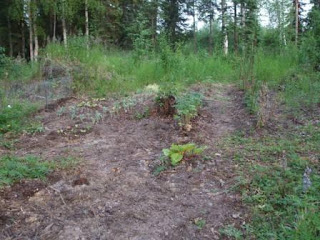
Well, my name isn't Mary, but I will show you how my garden grows. Everything is growing SO much better than last year. Our beds are quite rudimentary, hacked out of what was forest until sometime this spring. Hacked out by hand, I should point out, with nothing more than a couple of pulaski's, a couple of shovels, and some elbow grease. Mix it with some all natural fertilizer bought at the mill and feed (my compost isn't ready yet), and some wood ashes, give it some sun and some water, and here we are:


This is everything except the potatoes, strawberries, scallions, mint, and grapes. This does include two rows of raspberries, storage onions, lettuce, broccoli, swiss chard, peas and rhubarb. I know you can't see a lot of detail, but you can see how it had been part of the forest. It's kind of neat walking through the woods, past our campfire ring, and down a little path and suddenly instead of wildness, there are these neat little rows of edible things growing.

Here's the raspberries:


I got a late start on the peas, just planted them a week or so ago:


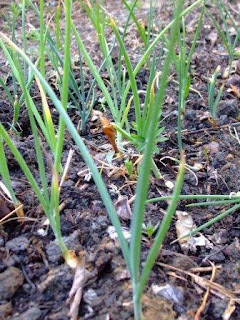
The storage onions:


Then, over in last year's beds, there are the potatoes and strawberries. The potato plants are much bigger than they ever got last year, and I am hoping the potatoes are as well. Last year we got lots of little potato marbles. We planted those marbles this year, and got:


And, last but not least, the strawberries, my favorite berry. The strawberries are out of control. Lots of nice, big, ripening berries, gazillions of runners everywhere:


I have to admit, although I love the strawberries the best, the thing I am most excited about, most hopeful over, and most anxiously awaiting harvest on, is the potatoes. Potatoes are a staple crop, and are nutritionally and calorie dense. If all else fails, potatoes will keep us alive. And with proper storage, will easily stay good until close to the next harvest. So I am hoping they produce this year. It is only my second year growing them, so I am certainly not counting my chickens before they hatch, but I am hoping I can get them mastered.

But, yeah, I really, really love strawberries.

Wednesday, June 24, 2009

a learning experience


These are parsnips. A yummy, white root vegetable very similar to carrots. They are from my garden. But they are in my compost bin. So what happened??? Well, last summer was terrible for growing. Nothing in my garden grew well last year. Well, we were happy to see our parsnips growing this spring, and were hoping that they would finally get to harvestable size....
NO! I was reading the other night in "The Backyard Homestead" by Marjorie Page, and came across a section regarding wintering vegetables over in the garden. I was reading with interest, and it said, regarding parsnips, "be sure to harvest before second growth begins, as they become poisonous at that time." Whoa! This was total news to me. So we promptly pulled all the parsnips up and put them in the compost pile.
This was sort of a learning experience for me. I am not an experienced vegetable gardener. I am just sort of going along, learning, seeing what works. I knew things like rhubarb leaves are toxic, and if potatoes are left in the sun, they become inedible. But I had no idea about this. And these sorts of things are IMPORTANT. This was something I really needed to know before feeding them to my family. I shudder to think what could have happened if I hadn't happened to pick this book up at Barnes and Noble last week.
I guess my point is that it is important when you are embarking on a new project, to learn what you can from other sources, and not do it all by personal experience. Otherwise, you are in for some personal experiences that are less than pleasant.

Monday, February 16, 2009

is a global food shortage looming this summer?

http://www.marketoracle.co.uk/Article8768.html

This was an interesting article to read. The analysis is very simple. It looks at which countries produce the most food, and which countries are experiencing drought. Basically, all of the countries that produce large amounts of food are experiencing moderate to severe drought. Just based upon lack of rainfall, it appears that globally, we are going to have at least a 20 to 40% decrease in food production this year. And, yes, here in the USA too.

I have mentioned before that right now, we have the lowest food reserves in decades. Now is a really bad time to not be able to grow enough food, since we don't have enough stored to make up the difference.

We should all be doing the Victory Garden thing this year. Not only for our own food security, but every little bit we don't have to buy is some left over for someone else. But if we don't have enough water for farmers, will we have enough for everyone to have a vegetable garden?

It is high time to look at the ways we use water, and make decisions about what is really important. Is it more important to have a green lawn of grass in Las Vegas, Salt Lake City, or any of the other naturally dry areas, or is it more important to use that water to grow food? Is it really a good idea to take perfectly clean drinking water to flush our waste away? What can we do to conserve water, individually, and at a societal level, for the most important things?

Monday, January 26, 2009

Uh-oh

http://www.msnbc.msn.com/id/28808767/


Hello, global warming. This article reports that many farmers in California are not planning on planting this year, or don't know if they will be able to plant this year, due to drought. This isn't just little bitty farms, this is from some of the largest farmers, affecting thousands of acres of crops.

So, water shortages, food shortages, what next? We waited too long, and did nothing. This is going to get ugly. Just sayin'.

Thursday, February 28, 2008

stocking up

I am reading a lot these days about food. Specifically, about whether there is enough to go around. The general consensus seems to be that there is not, despite the apparent abundance in our grocery stores. Here are a few examples:

  • The United Nations is reporting that they are not able to continue to feed the numbers of hungry people they have been feeding. The article states, "With voluntary contributions from the world's wealthy nations, the WFP [World Food Program] feeds 73 million people in 78 countries, less than a 10th of the total number of the world's undernourished. But with annual food price increases around the world of up to 40% and dramatic hikes in fuel costs, that budget is no longer enough even to maintain current food deliveries." http://www.guardian.co.uk/environment/2008/feb/26/food.unitednations

  • China is facing renewed fears that its growing demand for grain to feed the world’s largest population may lead to imports from international markets, driving prices higher and spurring further food inflation. http://www.ipsnews.net/news.asp?idnews=41345
  • Venezuela is experiencing severe food shortages, and is halting exports of many food items. http://www.news.com.au/story/0,23599,23277253-1702,00.html

  • The world’s wheat stockpiles have fallen to their lowest level in 30 years, and stocks in the United States have dropped to levels unseen since 1948. http://www.nytimes.com/2008/02/13/business/13wheat.html?_r=2&ref=business&oref=slogin&oref=slogin

  • Smithfield Foods, one of the largest pork processors in the United States, is reducing its U.S. breeding herd by 4% to 5%, or 40,000 to 50,000 sows, because of rising grain costs. That means Smithfield ultimately will produce 800,000 to 1 million fewer market hogs annually, the company said. Smithfield currently raises 18 million market hogs a year. This article was on CNN Money, but is no longer available online.

  • In the wheat price surge this week, the leading wheat contract has risen by more than the entire worth of the contract just months ago. Prices rallied by $5.75 a bushel on Monday, being up by nearly 30% at one point compared with Friday’s close. Eight months ago on June 19, the lead wheat contract settled at over $5.00 a bushel. http://nqr.farmonline.com.au/news_daily.asp?ag_id=48995

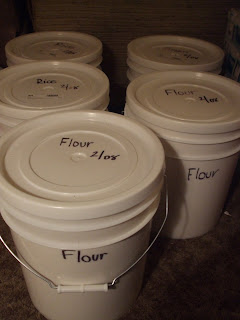
All of this is making me distinctly nervous. Food shortages around the world, record wheat prices, and our idiotic president is encouraging more of our corn be turned into biodiesel and ethanol. It is enough to make me really glad I am starting a garden this year. And determined to grow a lot of potatoes. We also did this:


These are five gallon buckets. Two each of rice and flour. One of sugar. It's not enough, but its a start. Makes me feel at least a little bit better.

Sunday, February 24, 2008

salmon

James likes to fish. Plus, we all like to eat fish. However, when the fish is buried in the bottom of the freezer, it doesn't get eaten very quickly. We are going to be moving into our cabin sometime in the near future, and we won't have a freezer once that happens. Why? Because we won't have electricity. And it is almost March and the snow will start melting soon, so we can't even bury our frozen meats outside. So, I had to do something about the bags of fish in the bottom of our freezer. I got out my pressure canner and glass jars, and canned it. We now have 2 pints and 24 half-pints of salmon. (The 2 pints are because I ran out of half-pint jars). Every single jar sealed. I was very pleased, especially since it was the first time using my pressure canner. Check it out:

I am feeling like I had a productive weekend.

Monday, February 11, 2008

kiss your grass goodbye...


Sharon posted a great piece about victory gardens on her blog the other day. Give it a read:


There are lots of reasons to bring back victory gardens, including but not limited to:
  • Right now, our food travels an average of 1500 miles to get to our table. (Further if you happen to live in Alaska). That's a lot of emissions, and our climate is in trouble.
  • Industrial agriculture is in trouble. With the specters of climate change, drought, peak oil, and shortages of fertilizer (likely fairly permanent), the yields of industrial farmers will drop, possibly precipitously.
  • Speaking of fertilizer, industrial fertilizers, insecticides, pesticides and such are really not good for people to eat. If you grow your own produce, you control how much crap goes on it.
  • Every time I go to the grocery store, I notice that food seems to be getting more and more expensive. Growing your own insulates you from this to some degree.
  • I read this morning that the US wheat stocks are at a 60 year low. This will only get worse as more and more farmland is converted to growing corn for biodiesel and ethanol.
  • and, of course gardening is great exercise.

Seriously, there are lots of reasons to grow your own food, and encourage your neighbors to do the same. The politicians keep yammering about achieving energy independence, and this is a start.

Thursday, February 7, 2008

What is food made of?

So, I was in the middle of cooking dinner the other night, and my four year old had a question. Four year olds are notorious for their ability to ask questions that parents don't know the answer to. He asked me, "What is food made of?" A fairly simple question, and I am not even sure what I said in reply, but I have been pondering it for days.

What is food made of?

Well, I guess it depends. If you eat a fairly good diet, food typically consists of a variety of ingredients that are generally recognizable as either plant or animal. For example, that night, I was making spaghetti. In my spaghetti sauce, I include tomatoes, tomato sauce, onions, mushrooms, garlic, oregano, basil, and a few other spices, as well as a scant tablespoon or so of organic sugar. And spaghetti sausage, which consists of meat and spices. All of these ingredients are fairly straight forward, and readily identifiable.

But the spaghetti noodles? Their ingredients are wheat, niacin, iron lactate, thiamine mononitrate, riboflavin, and folic acid. The wheat is obvious. But the other things sound like they come from a chemical plant, not a garden. And, yes, I know that a lot of it is the vitamins that they use to enrich the flour the noodles are made of. BUT... that enrichment would not be necessary if they were made of whole wheat, which has not had the vitamins stripped out of it during processing.

But it is vastly cheaper to buy noodles that have had the vitamins stripped out of them and then artificially replaced, than it is to buy noodles that are made with wheat that has been left alone and closer to its natural state. Weird, huh?

And there is even more to the story. How many people have seen the movie Shrek? Well there is one part where Shrek tells Donkey that ogres are like onions. Donkey is confused, and thinks he is talking about the fact that they both stink. But he isn't. He explains that onions have layers, and so do ogres. If you haven't seen Shrek, you can see it here, in relevant part:

http://www.youtube.com/watch?v=t9nJlXLF06k

Fun, huh? Great movie. It's one of those great kids movies that the adult jokes go right over the kids heads, but keeps both kids and adults well entertained. Disney has gotten really good at that lately. Or maybe I have just gotten old enough to understand them? I digress.

My point is about layers. My spaghetti sauce. On the surface, as I said, the ingredients look pretty close to where they came from. But the tomatoes and tomato sauce? They have been canned, and I know what happens to vegetables when they are canned at home, but what happens to them in industrial canning? I don't know. But they are not organic tomatoes, so they are almost certain to have pesticides, synthetic fertilizers and whatnot on or in them. So do I need to add pesticides to my list of what food is made of? How do I explain that to a four year old? Actually, I didn't.

I have to say that I am the last person that should be complaining about what our food is made of... after all, I practically live on diet pepsi, which as far as I know, doesn't have a single ingredient that exists outside of a soda factory. But I know that I shouldn't, and that I need to quit one day. I know I would be healthier and feel better if I ate closer to nature, and that includes drinking something less chemical laced than diet pepsi.

It is something to think about.

Monday, January 21, 2008

A lesson in making do

We spent the weekend at our cabin. Because the cabin is only heated on weekends, we don't store food there, as it would freeze, cans would burst, etc. Every week, before we leave to go to the cabin, I pack what food I think we will need for however long we will be there.


When I am planning meals for the time we are there, simplicity is key. I cook on a Coleman stove, like this one:

and I use cast iron pans. We do dishes in a plastic tub with water heated on the stove. So I plan meals that require a minimum of preparation, can be cooked in a maximum of two pots, and doesn't have to be watched/stirred every two seconds.

Anyway, one of the things I planned on cooking this weekend was chili. Usually, I make chili from scratch, but I saw a mix at the grocery store that looked both easy and halfway decent. I quickly glanced at the back, saw that the instructions called for adding 7 cups of water, bringing to a boil, and simmer for 25 minutes. So, up at the cabin, I am throwing dinner together. I browned some ground beef to go in it, and was reading the back of the package again, and noticed "and whisk in 2 6-oz cans of tomato paste". WHAT???? TOMATO PASTE??? DAMMIT. So, I looked, just to make sure, and nope, I don't have any tomato paste. So, I asked Ryan how many cans of tomato sauce did he pack for the sloppy joes we had eaten the night before? One. Exactly how many I had told him to. DAMMIT.

James had been thinking about going to the store for ice cream. So, I asked him to pick up tomato paste while he was there. So, off he went for the 1o mile drive to the store. Back he came 10 minutes later. He wasn't going to the store. It had warmed up considerably, and had been raining. This turned the hill we live on into a solid sheet of ice covered in a thin layer of water. It turned out that even before starting to head down the hill, he had little to no control of his van. And there was a person in the ditch that also apparently had little to no control of their vehicle. Deciding (in an uncharacteristic moment) that discretion is the better part of valor, he came home, and informed me that I would have to make chili without tomato paste.

Chili without tomato paste? EEEWWW. I fussed over this a few minutes, and then thought about it. We had the ground beef. We had chili mix, and after reading the ingredients, found that it consisted of beans, rice, and spices. So, I made the chili, minus the tomato paste, and we had southwestern style soup. Topped with cheese and eaten with tortilla chips, it was tasty. Maybe not as yummy as chili, but no one complained.

I guess the whole point of this is that sometimes you have to make do. You don't always have everything to make the recipe exactly as called for, and this goes for more than just dinner. It goes for just about anything in life. With the uncertain times we live in, with problems ranging from global warming to recession, we might find ourselves needing to make do with less than what we normally would. And you just have to say, "DAMMIT" and make it work.

Thursday, October 11, 2007

not looking good down under

http://www.planetark.org/dailynewsstory.cfm/newsid/44719/story.htm

I have heard for a while about the drought in Australia, and that it is affecting the wheat harvest. I didn't realize, however, that Australian farmers have already lost 40% of their harvest. That is really, really, bad. Wheat stores worldwide are already at a low level not seen in at least 26 years, and Australia is not the only part of the world facing drought and crop loss. And as global warming intensifies, it will only get worse.